
Ethereum staking just hit an all-time high, with roughly 36 million ETH, almost 30% of the total supply, now locked up securing the network.
Launched in 2015 by Vitalik Buterin and a team of developers, ETH has evolved from a proof-of-work consensus mechanism, similar to Bitcoin’s mining process, to proof-of-stake following the Merge upgrade in September 2022.
This shift allows participants to secure the network by staking ETH rather than using energy-intensive hardware, making the system more efficient and environmentally sustainable.
Staking is like putting your ETH into a savings account that helps run Ethereum. You lock up ETH, and in return, you earn rewards for helping validate transactions. Right now, that base reward usually sits around 3–5% a year.
One out of every three ETH coins is now locked and unavailable for quick selling. Less liquid supply often reduces selling pressure.
(Source: Staking Rewards)
This milestone reflects growing confidence in the platform’s long-term viability, as stakers contribute to transaction validation while earning rewards. The staked amount equates to over $119.79 billion at current market values.
EXPLORE: Best Memecoins to Buy in 2026
Institutional Participation Is Fueling the Ethereum Staking Expansion
Institutions have emerged as a dominant force in Ethereum staking, committing substantial volumes that underscore their strategic focus on the asset. Data indicates that major players, including funds, custodians, and services tied to exchange-traded funds (ETFs), have staked over 10 million ETH collectively.
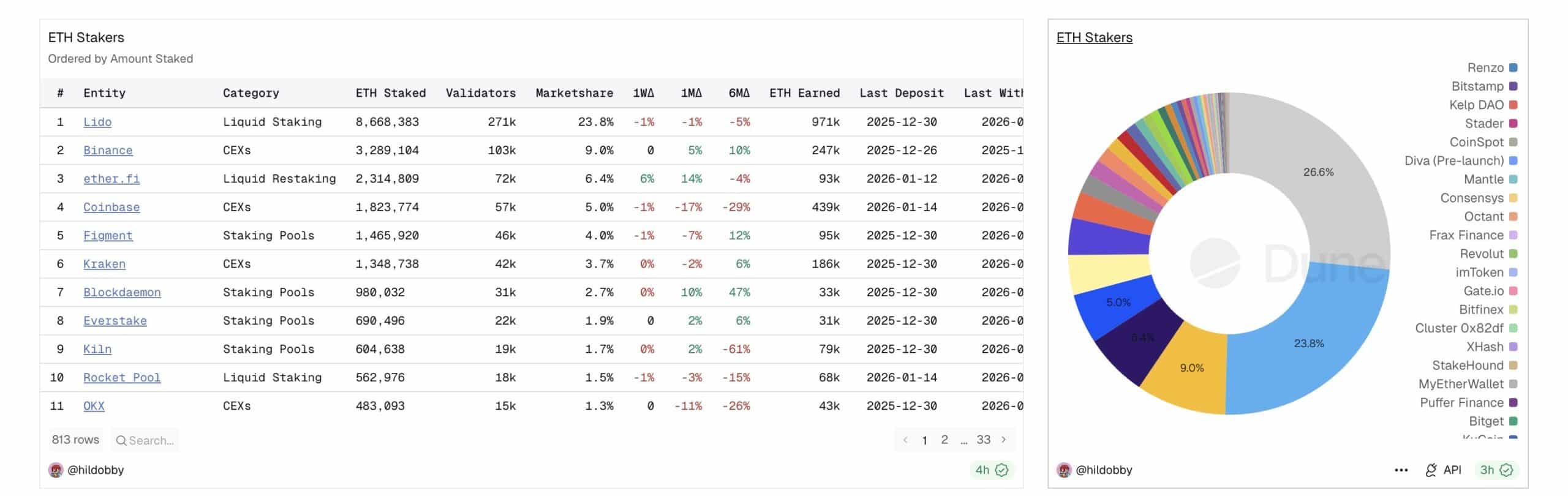
(Source: Dune)
For instance, BitMine Immersion Technologies alone has staked more than 1.25 million ETH, representing a 90% increase in its position over the past week and generating an estimated $93-100 million in annual rewards.
Overall, institutional staking now accounts for a significant portion of the total, with protocols like Lido Finance handling about 24% of all staked ETH.
Big players rarely lock assets for long periods unless they expect stability and clear rules.
DISCOVER: Meme Coins Explode 8% Overnight: But The Real 100x Opportunity Is Maxi Doge
What is Pushing Individuals and Institutions to Stake Their ETH? Liquid Staking Changed the Game
Participants stake ETH for a variety of strategic and practical reasons. At the core, staking provides an opportunity to earn passive income through network rewards, which are distributed in ETH for validating blocks and maintaining consensus.
Not all stakers want to lock funds completely. Liquid staking tokens, often called LSTs, solve this by giving you a tradable receipt while your ETH stays staked. Platforms like Lido and Ether.fi dominate here, though market share has shifted over time.
Ethereum’s price has exhibited a pattern of consolidation followed by upward momentum in early 2026. After trading sideways in a $3,000 to $3,300 range throughout the first half of January, ETH experienced a 5% increase on January 14, reaching $3,380 and breaching the $3,300 threshold for the first time this year.
$ETH has broken above the $3,300 level.
Ethereum just needs to reclaim the $3,450 level, and the rally towards the $4,000 level could happen quickly.
If ETH gets rejected from the $3,450 resistance zone, the entire rally could get retraced. pic.twitter.com/MbmNuMbnyF
— Ted (@TedPillows) January 14, 2026
When ETH gets staked, it leaves the open market. That reduces circulating supply, which can support prices during demand spikes. It does not guarantee price gains, but it changes the math compared to earlier cycles.
DISCOVER:
- 16+ New and Upcoming Binance Listings in [2026]
- 99Bitcoins’ Q4 2025 State of Crypto Market Report
Follow 99Bitcoins on X For the Latest Market Updates and Subscribe on YouTube For Daily Expert Market Analysis.
The post ATH for Ethereum Staking: Nearly 30% of ETH Is Now Locked appeared first on 99Bitcoins.
#ATH #Ethereum #Staking #ETH #Locked
#ATH #Ethereum #Staking #ETH #Locked
