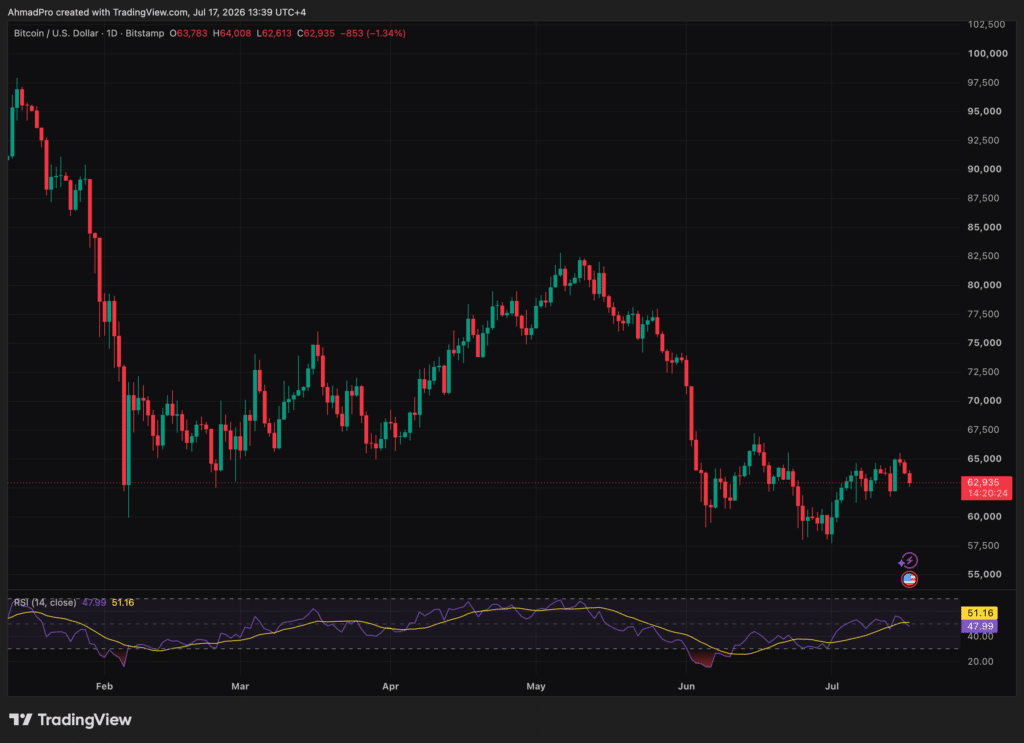
In Bitcoin ETF news today, US-listed spot BTC ETFs recorded a second consecutive week of net inflows after nearly two months of capital flight, pulling in $75.7M last week and $197.4M the week before, a combined $273.1M that has snapped an outflow rout that had drained more than $8.2Bn from the 13 funds.
The central question the market is now wrestling with: is this a genuine turning point in institutional sentiment, or a fragile bounce propped up by one soft jobs report ahead of a Fed meeting that could rewrite the script entirely?
Spot Bitcoin ETFs Record $197 Million in Weekly Net Inflows, Ending Eight-Week Outflow Streak
From July 6 to 10 (ET), U.S. spot Bitcoin ETFs recorded $197 million in net inflows, ending an eight-week outflow streak. Spot Ethereum ETFs saw $84.42 million in net inflows, also… pic.twitter.com/OyW00HA76o
— Wu Blockchain (@WuBlockchain) July 13, 2026
Bitcoin price context matters here. The recovery began after BTC fell below $58,000 in late June, then climbed back toward the $63–65K range by mid-July as ETF inflows resumed.
The asset has not reclaimed a decisive higher level, which means the flow recovery and the price recovery are moving in lock-step but neither has yet confirmed the other.
Bitcoin ETF News: Two Months of Bleeding, Two Weeks of Relief

(SOURCE: CoinGlass)
From early May to late June 2026, US spot Bitcoin ETFs lost over $8.2Bn in net assets, pushing BTC to its lowest level since late 2024 and raising doubts about institutional adoption.
The recovery began on July 2 with net inflows of $221.7M, ending a 10-day outflow streak. Fidelity FBTC led with $165.96M, ARK ARKB added $91.84M, while BlackRock IBIT faced outflows of $40.43M.
On July 6, the funds experienced their largest single-day inflow in over a month, totaling $265.7M, primarily driven by IBIT. From July 2–7, the total inflow reached approximately $510M.
Despite a setback on one Monday due to geopolitical tensions, a subsequent three-day inflow streak of $181M, $108M, and $79.2 million resulted in a positive weekly total of $75.7M.
What Actually Triggered the Reversal for the Bitcoin ETF News Data Drop?
The macro catalyst was a single data release on July 2, when the US Bureau of Labor Statistics reported that 57,000 jobs were added in June, falling short of expectations, alongside a rise in unemployment to 4.2%.
Bitcoin ETF flows are now closely tied to the same macro factors affecting traditional risk assets. When inflation expectations ease and fears of rate hikes diminish, investment advisers have more leeway to increase BTC exposure. Conversely, when the macro outlook worsens, as happened during US-Iran tensions, flows can reverse quickly.
This reflects a structural feature of the post-ETF Bitcoin market, where a significant portion of BTC volume occurs during US trading hours, heightening price sensitivity to US economic data. Reports on jobs, CPI, and Fed outcomes have become key catalysts for Bitcoin.
Nick Ruck of LVRG Research described this inflow dynamic as “cautious position rebuilding” amid previous profit-taking. Institutions gradually entered through FBTC and ARKB before moving into IBIT once signs of recovery became evident.
EXCLUSIVE: Earn $10 USDC Via Binance Sign-Up
IBIT Re-Asserts Dominance And What That Signals
According to SoSoValue data, U.S. spot Bitcoin ETFs recorded total net inflows of USD 79.15 million on July 16, led by BlackRock’s IBIT with USD 33.44 million. Spot Ethereum ETFs posted total net outflows of USD 28.04 million, although Bitwise’s ETHW recorded the largest… pic.twitter.com/jgejDWUYgs
— Wu Blockchain (@WuBlockchain) July 17, 2026
The fund-rotation sequence during the recovery reveals key insights. On July 2, IBIT was in outflow at -$40.43M, with Fidelity FBTC and ARK ARKB leading inflows. By July 6, IBIT flipped to +$209.4 million, dominating the day’s total inflow of $265.7M and marking its resurgence as a primary institutional conduit.
This pattern reflects how large advisory platforms behave during uncertainty, exiting liquid vehicles first and returning when conditions stabilize. IBIT’s return to flow leadership suggests that institutional investors are regaining confidence in the macro environment.
In contrast, GBTC, Grayscale’s Bitcoin Trust, saw -$44.45M in outflows on July 6, indicating a trend of holders migrating to cheaper alternatives due to higher fees, rather than reflecting Bitcoin sentiment.
For those tracking ETF flows as signals of institutional sentiment, the key indicator is consistent IBIT inflows over multiple sessions rather than a single day’s performance. Sustained positive net flows, anchored by IBIT leadership, carry different significance.
DISCOVER: Best Meme Coin ICOs to Invest in 2026
The Uncomfortable Context Behind the Recovery Numbers
Two consecutive positive weeks might seem bullish, but the context is concerning. Year-to-date 2026 net outflows from 13 US spot Bitcoin ETFs total about $5.4Bn, despite recent recovery of $273.1M, which is just 3.3% of the $8.2Bn lost during the outflow rout.
Cumulative net inflows are around $51.2Bn, with total assets under management (AUM) at approximately $77.7Bn, indicating significant institutional interest but also unrealized losses at current BTC price levels.
TechTimes describes the situation as a “repair observation window,” emphasizing that sustained inflows above $500 million weekly, a net-positive IBIT for a month, and BTC maintaining $68–70K are needed for a confirmed recovery.
Additionally, geopolitical factors add volatility, as evidenced by the $424.7M outflow on July 14 amid US-Iran tensions, highlighting the risk of rapid outflows that could quickly erase recovery gains.
July 28 Is the Next Binary Event for Bitcoin
I’m watching the clock this morning, the bounce held the whole weekend, BTC is near $64,200 and the fear gauge has thawed, but the test I flagged is now hours away, not days.
I’m staying flat into the open, because the weekend rallied with equities shut, and 9:30am is the first…
— Ted (@TedPillows) July 20, 2026
The Federal Open Market Committee (FOMC) meets on July 28 to decide the US benchmark interest rate. Markets expect a hold, influenced by weak June jobs data and moderating inflation, which could boost Bitcoin ETF inflows for a third week.
Conversely, a hawkish surprise, such as a rate hike or increased inflation projections, could lead to outflows from Bitcoin ETFs.
Bitcoin is currently trading in the $63–65K range, recovering from sub-$58,000 lows, but still below levels that institutional investors would consider profitable.
Assets under management across 13 funds rose from $70.95Bn at the end of June to about $77.32 billion in early July, driven by both price appreciation and net inflows.
EXPLORE: Best Crypto Presales With Asymmetric Upside in the Current Market

Why you can trust 99Bitcoins
Established in 2013, 99Bitcoin’s team members have been crypto experts since Bitcoin’s Early days.
90hr+
Weekly Research
100k+
Monthly readers
50+
Expert contributors
2000+
Crypto Projects Reviewed


Follow 99Bitcoins on your Google News Feed
Get the latest updates, trends, and insights delivered straight to your fingertips. Subscribe now!
Subscribe now 

#Inflows #Surge #273M #2Month #Rout